








01
Uploaded Files
Context files are imported directly, which is enough to run a campaign through the approval lifecycle.

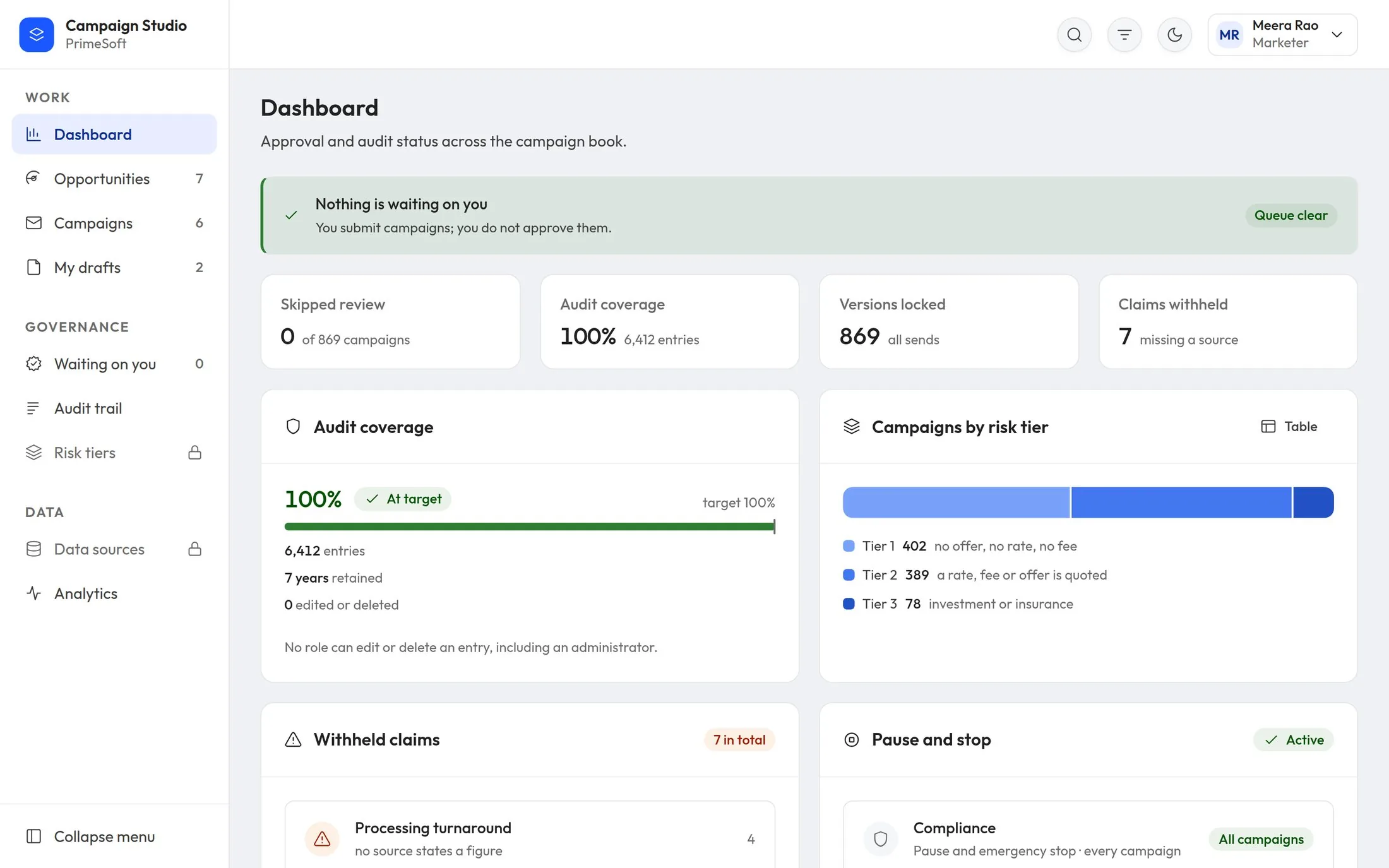
These are properties of how the platform is built, guarantees you’ll get during rollout.
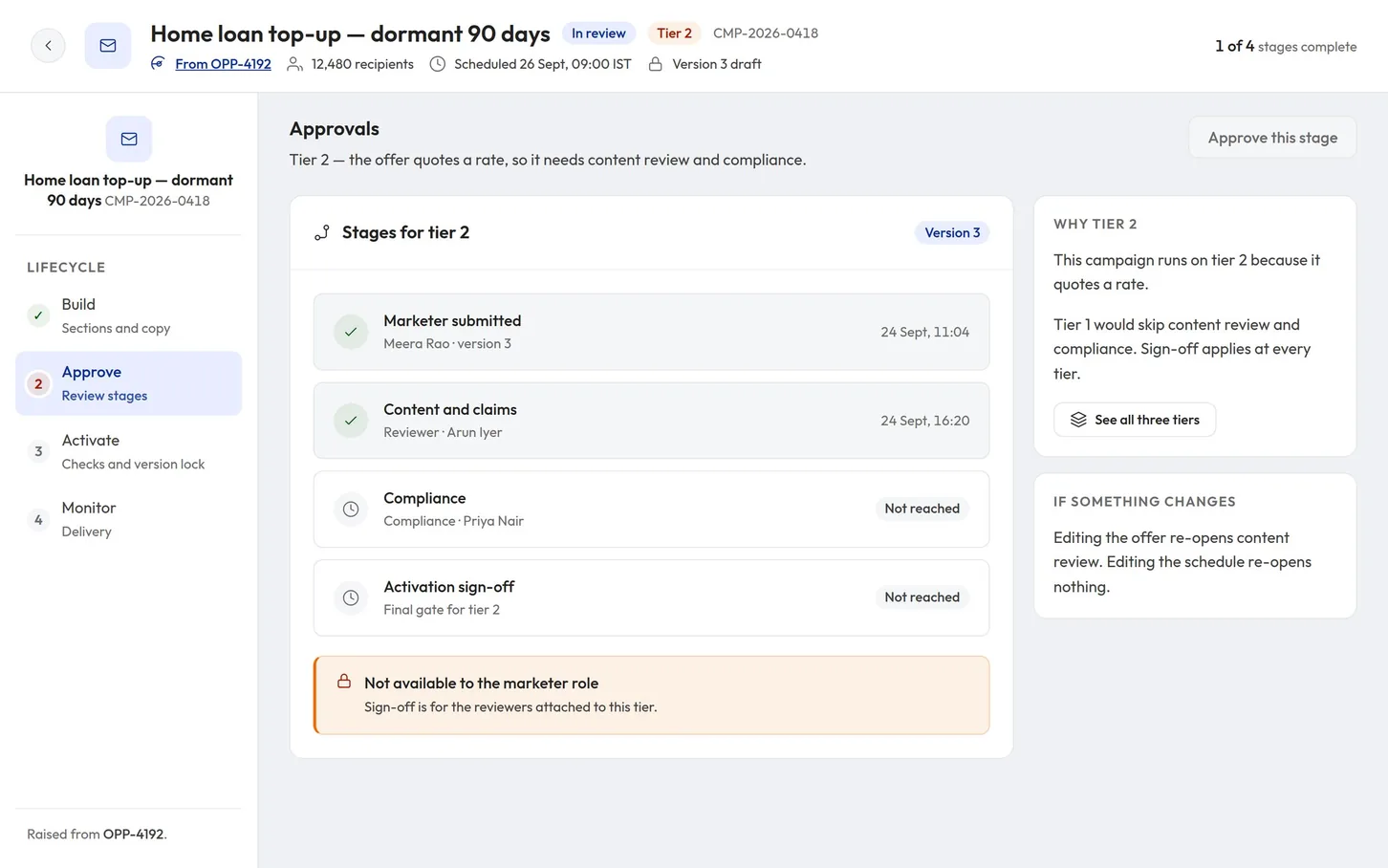
One straight-through path connects the four groups who touch a campaign: the marketer who builds it, the reviewer who checks it, the compliance officer who signs it off, and the administrator who sets the rules.
Signals from your core banking system, CRM and data warehouse surface a campaign opportunity, with reasons.
AI proposes the campaign structure, the journey and the email copy. Each section is accepted or edited on its own, so the parts that are right stay and the parts that miss get reworked.
Campaigns are routed by the risk tiers your institution defines. A low-risk campaign takes a shorter path, and the final activation sign-off stays in place at every tier.
Approvals, decisions and versions are logged and timestamped as they happen, so an examination request is answered from the system rather than assembled by hand.
The first campaign runs from an uploaded audience file. Live connections to your systems come later, on your schedule.
Approval is the start of the control rather than the end of it. What happens between sign-off and delivery is held as tightly as the review itself.
Only the reviewed audience, content, offer, journey and schedule get activated. A change re-opens only the review stage it affects.
Approvals, decisions and versions are logged and permanently retained, beyond the reach of administrator edits.
Risk tiers and reviewers are assigned by you. Final activation occurs only after required sign-off based on risk.
Pause and emergency stop stay available throughout delivery. Marketing and compliance both hold stop authority.
The same five steps apply whether the campaign was drafted by hand or with AI assistance.
Begin with a spreadsheet and move to live connections when the volume justifies it.
Context files are imported directly, which is enough to run a campaign through the approval lifecycle.

Recurring data feeds refresh the audience on a set cadence as campaign volume grows.

A direct connection to an API or data warehouse keeps the platform current with lower operational touch.
Webhook and event-stream sources drive opportunity detection very fast, as customer actions happen.
Three principles shape the platform, and they apply the same way in every deployment.

AI cannot submit, approve, schedule or activate a campaign.
Audit retention, version locking and risk-based routing are built into the platform structure.
A file import is enough to launch. Live data connections follow on.
A pilot takes one real campaign from detected opportunity through to results, on your data and your approval rules.